History & Lineages (Nieuwe Luchtige Stijl)Diepzwart #07080B met mist-overgang naar #DDDCCF)- Gouden label:
WING CHUN — ROOTS & CHRONOLOGICAL EVOLUTION - Hoofdtitel (Serif): HISTORY & LINEAGES
- Introductietekst:
Born in secrecy, forged under pressure, and carried across oceans. Trace the living history of Wing Chun — from underground resistance clans and the Southern Chinese Red Boats to the master teachers who shaped its modern branches.
- Verticale kalligrafie (links uitgelijnd onder de tekst op de grens naar
#DDDCCF):傳承
(Chuen Sing — “Erfgoed & Overdracht”)
- Gouden label:
Warm Perkament #DDDCCF — De Oorsprong & De Rode Jonken)100px padding boven en onder, met 80px witruimte tussen Era 01 en Era 02.)- Blok A —
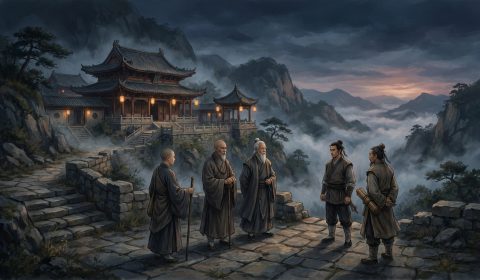
ERA 01 | 17TH TO 18TH CENTURY(Tekst links, afbeelding rechts)- Koptekst: The Southern Shaolin Mystery & The Red Society
- Tekst:
The earliest roots of Wing Chun lie at the crossroads of history and resistance mythology during the turbulent Qing dynasty. Following the fall of the Ming dynasty, Southern China became a stronghold for underground resistance movements — most notably the Hung Mun (Tiandihui, or Heaven and Earth Society), also known as the Red Society after the legendary red glow seen in the heavens by its founders.According to oral tradition, after the destruction of the Southern Shaolin monastery in Fujian, five surviving masters — known as the Five Elders (Ng Mui / Wu Mei, Abbot Jee Sin, Bak Mei, Fung Do Dak, and Miu Hin) — scattered across the south. To protect their identity from imperial authorities, resistance fighters encoded their combat knowledge in oral stories, hand signs, and symbolic names such as “Wing Chun” (“Eternal Spring”) — ensuring the art could survive in secrecy.
- Blok B —
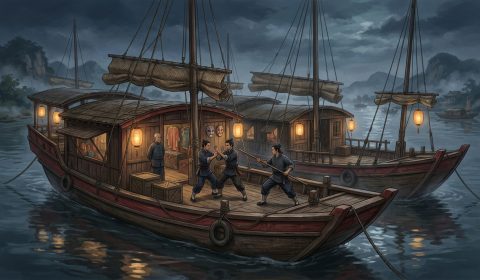
ERA 02 | CIRCA 1850 (HUNG SUEN)(Jouw Red Boats-illustratie links, tekst rechts)- Koptekst: The Red Boats: Forged for Reality
- Tekst:
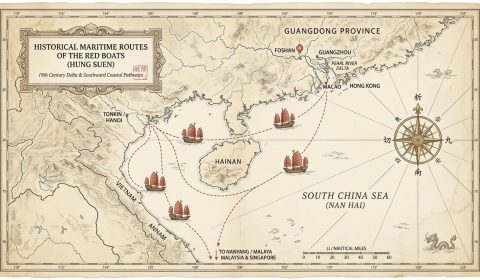
The clearest historical foundation of Wing Chun emerges in the mid-19th century aboard the Red Boats (Hung Suen) — traveling Cantonese opera troupes navigating the waterways of Guangdong. During the Red Turban Rebellion, these boats served as mobile sanctuaries and training grounds for revolutionaries and mercenaries.Classical martial arts required a decade of deep stances and elaborate routines before a student could fight effectively. On the narrow, unstable decks of a riverboat — and for fighters who needed to be combat-ready in months rather than years — there was no room for ornament. Pioneers such as Abbot Jee Sin (disguised as a boat cook, passing down the Six-and-a-Half Point Long Pole), Wong Wah-bo, Leung Yee-tai, Dai Fa Min Kam (“Painted Face”), and Yik Kam forged a compact, lethal system centered on a single 108-movement training form (Siu Lin Tao), centerline control, and immediate close-range reflex. Even today, this living heritage is documented in historical records such as Eduard Hildebrandt’s 1866 depiction “The Theatre at Macao” and celebrated through cultural Red Boat performances across the Pearl River Delta.
.
- Blok A —
Diepzwart #07080B met subtiele mist — Foshan & De Grote Takken)100px padding; eventueel uitklapbaar via een rustige Elementor Accordion per tijdframe als je de pagina compacter wilt houden.)- Blok C —
ERA 03 | LATE 19TH CENTURY (FOSHAN & GULAO)- Koptekst: Dr. Leung Jan & The Foshan Synthesis
- Tekst:
As the Red Boat era drew to a close, the scattered combat methods of the opera fighters converged in the bustling city of Foshan through Dr. Leung Jan, a respected herbalist and physician who became known across Southern China as the “King of Wing Chun.” Learning directly from Wong Wah-bo and Leung Yee-tai, Dr. Leung Jan tested, refined, and unified the system into an unmistakable standard of efficiency.Equally remarkable was how his teaching evolved later in life. Upon retiring to his native village of Gulao (Koo Lo), Dr. Leung Jan stepped away from teaching long, fixed solo forms altogether. Instead, he distilled the entire system into 108 / 116 loose, modular combat techniques (San Sik / Pin Sun Wing Chun) — proving that fixed forms are merely training vehicles, while direct application is the true goal.
- Blok D —
ERA 04 | 1900–1950 (DIVERGENCE)- Koptekst:
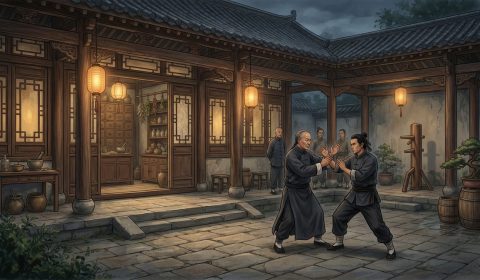
The Great Branches of Southern China, Vietnam & Malaysia - From Foshan, Wing Chun branched into distinct yet deeply connected lineages across Southern China and Southeast Asia. Through Fok Bo-chuen (Fook Yuen) and Fung Siu-ching (a direct disciple of Red Boat master Dai Fa Min Kam), the art passed to Yuen Kay-san — a scholar and martial theorist renowned for extraordinary suppleness and lightning-fast Chi Sau, whose branch was preserved and carried forward by his foremost disciple Sum Nung — while his elder brother Yuen Chai-wan carried the art to Hanoi to found the Vietnamese Vịnh Xuân lineage. Alongside them in Foshan stood Grandmaster Pan Nam, who preserved a distinct, internally rooted Foshan branch tracing back to Red Boat pioneer Tan Sau Ng, as well as Ng Chung-so, Chan Wah-shun’s senior disciple who kept the daily training halls alive. At the same time, pioneers such as Cho On (Cao Dean) and Yip Kin carried unadulterated Ban Chung and traditional Wing Chun methods southward into Malaysia and Singapore, where those older lineages took root decades before the art reached the West.Simultaneously, Dr. Leung Jan’s disciple Chan Wah-shun and his son Leung Bik passed their knowledge to Ip Man, who later relocated to Hong Kong in 1949. From Hong Kong, Ip Man’s students — including Wong Shun Leung, Chu Shong Tin, and Leung Ting — carried Ving Tsun (VT) and WingTsun (WT) onto the global stage.
- Koptekst:
- Blok C —
Warm Perkament #DDDCCF — Seattle & Shadow Arts)- Blok E —
ERA 05 | 1959–1975 (UNADULTERATED RED BOAT ROOTS)- Koptekst: Master Fook Yeung & The Seattle Bridge
- Tekst:
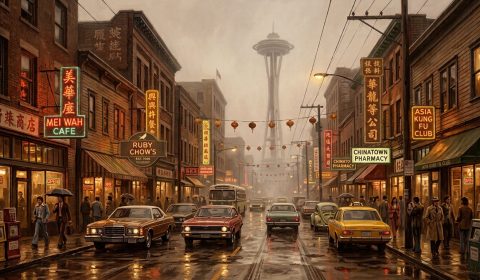
While Hong Kong popularized structured Wing Chun, an older, direct current from the Red Boats traveled straight to the American Pacific Northwest through Master Fook Yeung (Yeung Fook). A former Red Boat opera performer and lifelong friend of Bruce Lee’s father, Fook Yeung took in the young Bruce Lee upon his arrival in Seattle in 1959.Living in Fook Yeung’s home and training under his private guidance for years, Lee absorbed unadulterated Red Boat Wing Chun woven seamlessly with Southern and Northern Praying Mantis, Bak Mei, and internal Nei Gong. This raw, non-classical approach — stripping away rigid choreography in favor of live structure, trapping, and instant adaptability — planted the direct seed for Jeet Kune Do and Jesse Glover’s Non-Classical Gung Fu. Master Fook Yeung later passed his complete Fook Yeung Chuan system to only a select few private students, notably David Harris and Steve Smith.
- Blok F —
ERA 06 | 1970–PRESENT (ONE ART, MANY LINEAGES)- Koptekst: Global Evolution & The Shadow Arts Approach
- Tekst:
From the 1970s onward, pioneers opened the doors of Wing Chun across Europe and the world — from Lee Shing and Austin Goh in London, to Keith Kernspecht’s EWTO across continental Europe, alongside specialized lineages such as Hung Fa Yi (Garrett Gee’s science of Time, Space, and Energy) and internal Wumei Kungfu (such as Yap Boh Heong).At Shadow Arts, we stand above organizational politics and lineage rivalry. We honor every branch — whether trained through the 108-move Siu Lin Tao, the modern three forms, Dr. Leung Jan’s 108/116 San Sik, or Fook Yeung’s direct Red Boat methods — uniting them under one timeless principle: from structured form to spontaneous freedom.
- Blok E —
Diepzwart #07080B — 3 knoppen op één rij)- Knop 1:
← BACK TO WING CHUN - Knop 2:
NEXT: FORMS & SAN SIK → - Knop 3:
PHYSICAL DOJO (BAARN) →
- Knop 1:
- Gouden subtitel:
WING CHUN — ROOTS & CHRONOLOGICAL EVOLUTION - Hoofdtitel: HISTORY & LINEAGES
- Introductie:
Born in secrecy, forged under pressure, and carried across oceans. Trace the living history of Wing Chun — from underground resistance clans and the Southern Chinese Red Boats to the master teachers who shaped its modern branches.
- Gouden subtitel:
- Gouden label:
ERA 01 — LEGEND & RESISTANCE - Tekst:
The earliest roots of Wing Chun lie at the crossroads of history and resistance mythology during the turbulent Qing dynasty. Following the fall of the Ming dynasty, Southern China became a stronghold for underground resistance movements — most notably the Hung Mun (Tiandihui, or Heaven and Earth Society), also known as the Red Society after the legendary red glow seen in the heavens by its founders.According to oral tradition, after the destruction of the Southern Shaolin monastery in Fujian, five surviving masters — known as the Five Elders (Ng Mui / Wu Mei, Abbot Jee Sin, Bak Mei, Fung Do Dak, and Miu Hin) — scattered across the south. To protect their identity from imperial authorities, resistance fighters encoded their combat knowledge in oral stories, hand signs, and symbolic names such as “Wing Chun” (“Eternal Spring”) — ensuring the art could survive in secrecy.
- Gouden label:
- Gouden label:
ERA 02 — CIRCA 1850 | HUNG SUEN - Tekst:
The clearest historical foundation of Wing Chun emerges in the mid-19th century aboard the Red Boats (Hung Suen) — traveling Cantonese opera troupes navigating the waterways of Guangdong. During the Red Turban Rebellion, these boats served as mobile sanctuaries and training grounds for revolutionaries and mercenaries.Classical martial arts required a decade of deep stances and elaborate routines before a student could fight effectively. On the narrow, unstable decks of a riverboat — and for fighters who needed to be combat-ready in months rather than years — there was no room for ornament. Pioneers such as Abbot Jee Sin (disguised as a boat cook, passing down the Six-and-a-Half Point Long Pole), Wong Wah-bo, Leung Yee-tai, Dai Fa Min Kam (“Painted Face”), and Yik Kam forged a compact, lethal system centered on a single 108-movement training form (Siu Lin Tao), centerline control, and immediate close-range reflex.
- Gouden label:
- Gouden label:
ERA 03 — LATE 19TH CENTURY | FOSHAN & GULAO - Tekst:
As the Red Boat era drew to a close, the scattered combat methods of the opera fighters converged in the bustling city of Foshan through Dr. Leung Jan, a respected herbalist and physician who became known across Southern China as the “King of Wing Chun.” Learning directly from Wong Wah-bo and Leung Yee-tai, Dr. Leung Jan tested, refined, and unified the system into an unmistakable standard of efficiency.Equally remarkable was how his teaching evolved later in life. Upon retiring to his native village of Gulao (Koo Lo), Dr. Leung Jan stepped away from teaching long, fixed solo forms altogether. Instead, he distilled the entire system into 108 / 116 loose, modular combat techniques (San Sik / Pin Sun Wing Chun) — proving that fixed forms are merely training vehicles, while direct application is the true goal.
- Gouden label:
- Gouden label:
ERA 04 — 1900–1950 | DIVERGENCE - Tekst:
From Foshan, Wing Chun branched into distinct yet deeply connected lineages, each preserving vital facets of the art. Through Fok Bo-chuen (Fook Yuen) and Fung Siu-ching (a direct disciple of Red Boat master Dai Fa Min Kam), the art passed to Yuen Kay-san — renowned for extraordinary suppleness, internal power, and lightning-fast Chi Sau — and his elder brother Yuen Chai-wan, who carried the art to Hanoi and founded the Vietnamese Vịnh Xuân lineage.Simultaneously, Dr. Leung Jan’s disciple Chan Wah-shun and his son Leung Bik passed their knowledge to Ip Man, who later relocated to Hong Kong in 1949. From Hong Kong, Ip Man’s students — including Wong Shun Leung, Chu Shong Tin, and Leung Ting — carried Ving Tsun (VT) and WingTsun (WT) onto the global stage.
- Gouden label:
- Gouden label:
ERA 05 — 1959–1975 | UNADULTERATED RED BOAT ROOTS - Tekst:
While Hong Kong popularized structured Wing Chun, an older, direct current from the Red Boats traveled straight to the American Pacific Northwest through Master Fook Yeung (Yeung Fook). A former Red Boat opera performer and lifelong friend of Bruce Lee’s father, Fook Yeung took in the young Bruce Lee upon his arrival in Seattle in 1959.Living in Fook Yeung’s home and training under his private guidance for years, Lee absorbed unadulterated Red Boat Wing Chun woven seamlessly with Southern and Northern Praying Mantis, Bak Mei, and internal Nei Gong. This raw, non-classical approach — stripping away rigid choreography in favor of live structure, trapping, and instant adaptability — planted the direct seed for Jeet Kune Do and Jesse Glover’s Non-Classical Gung Fu. Master Fook Yeung later passed his complete Fook Yeung Chuan system to only a select few private students, notably David Harris and Steve Smith.
- Gouden label:
- Gouden label:
ERA 06 — 1970–PRESENT | ONE ART, MANY LINEAGES - Tekst:
From the 1970s onward, pioneers opened the doors of Wing Chun across Europe and the world — from Lee Shing and Austin Goh in London, to Keith Kernspecht’s EWTO across continental Europe, alongside specialized lineages such as Hung Fa Yi (Garrett Gee’s science of Time, Space, and Energy) and internal Wumei Kungfu (such as Yap Boh Heong).At Shadow Arts, we stand above organizational politics and lineage rivalry. We honor every branch — whether trained through the 108-move Siu Lin Tao, the modern three forms, Dr. Leung Jan’s 108/116 San Sik, or Fook Yeung’s direct Red Boat methods — uniting them under one timeless principle: from structured form to spontaneous freedom.
- Tijdframe 1 —
17e – 18e Eeuw | LEGENDE & HET VERZET (THE FIVE ELDERS)- De oorsprong: De val van de Ming-dynastie, de symboliek van de Zuidelijke Shaolin-tempel en de legendarische Five Elders (Ng Mui / Wu Mei, Jee Sin, Bak Mei, Fung Do Dak, Miu Hin). Het ontstaan van de geheime verzetsbroederschappen (Hung Mun / Tiandihui — de Red Society).
- Tijdframe 2 —
± 1850 | DE RODE JONKEN (THE RED BOATS)- De smederij op het water: Operagezelschappen op de Hung Suen (Red Boats) als dekmantel voor verzetsstrijders tijdens de Rode Tulband-opstand. Hier werd het systeem teruggebracht tot directe, compacte korte-afstandsefficiëntie door meesters als Abt Jee Sin, Wong Wah-bo, Leung Yee-tai, Dai Fa Min Kam en Yik Kam (Siu Lin Tao — 108 bewegingen).
- Tijdframe 3 —
Eind 19e Eeuw | DE FOSHAN & GULAO-SYNTHESE (DR. LEUNG JAN)- Verfijning & Modulariteit: Apotheker Dr. Leung Jan brengt de kennis van de Rode Jonken samen in Foshan, en ontwikkelt later in zijn geboortedorp Gulao de directe methode van 108/116 losse technieken (San Sik / Pin Sun) zonder lange vaste vorm.
- Tijdframe 4 —
1900 – 1950 | DE GROTE TAKKEN (YUEN KAY-SAN, VIETNAMESE & IP MAN)- Verspreiding vanuit Zuid-China: Via Fok Bo-chuen (Fook Yuen) en Fung Siu-ching ontstaat de verfijnde lijn van Yuen Kay-sanen de Vietnamese tak (Yuen Chai-wan). Tegelijkertijd groeit via Chan Wah-shun, Leung Bik en Ip Man de lijn uit die vanuit Foshan naar Hongkong trekt.
- Verspreiding vanuit Zuid-China: Via Fok Bo-chuen (Fook Yuen) en Fung Siu-ching ontstaat de verfijnde lijn van Yuen Kay-san
- Tijdframe 5 —
1959 – 1975 | DE SEATTLE-BRUG (MASTER FOOK YEUNG & BRUCE LEE)- Onversneden Red Boat-kennis in het Westen: Oud-operameester Master Fook Yeung vangt de jonge Bruce Lee op in Seattle (waar Bruce jarenlang bij hem in huis woont en traint). Fook Yeung geeft hem het rauwe Red Boat Wing Chun door — verweven met Praying Mantis, Bak Mei en Nei Gong — wat de directe kiem vormt voor Jeet Kune Do en Jesse Glovers Non-Classical Gung Fu, en later wordt doorgegeven aan David Harris en Steve Smith.
- Tijdframe 6 —
1970 – Heden | WERELDWIJDE EVOLUTIE & SHADOW ARTS- Van vorm naar vrijheid: De wereldwijde doorbraak in Europa en daarbuiten (via pioniers als Lee Shing / Austin Goh in Londen, Leung Ting (IWTA) / Keith Kernspecht (EWTO) en Hung Fa Yi / Wumei), en hoe Shadow Arts vandaag al deze lijnen eert zonder dogma’s: One Art, Many Lineages — United by Principle.
- Era 01 (
17e–18e Eeuw | The Southern Shaolin Mystery & The Red Society): 2-koloms kader — links jouw twee uitgebreide alinea’s in zacht lichtgrijs (#E0E0E0), rechts een 16:9-illustratie van het nachtelijke bergklooster met de Five Elders. - Era 02 (
± 1850 | The Red Boats: Forged for Reality): 2-koloms kader (gespiegeld) — links jouw bestaande 16:9-illustratie van de Red Boats, rechts de twee alinea’s over Hung Suen, Abt Jee Sin, Wong Wah-bo en Siu Lin Tao. - Era 03 (
Eind 19e Eeuw | Dr. Leung Jan & The Foshan Synthesis): Volledig breed gecentreerd kader met gouden omlijning (zoals op de tweede afbeelding), waarin de twee alinea’s over Foshan en de 108/116 losse San Sik-technieken rustig over twee kolommen of gecentreerd met ruime regelhoogte staan. - Era 04 (
1900–1950 | The Great Branches of Southern China & Vietnam): 2-koloms kader — links de tekst over Yuen Kay-san, Vietnamese Vịnh Xuân en Ip Man, rechts een sfeervolle 16:9-illustratie van een klassieke Zuid-Chinese trainingshal. - Era 05 (
1959–1975 | Master Fook Yeung & The Seattle Bridge): 2-koloms kader (gespiegeld) — links een 16:9-illustratie van een traditionele trainingsruimte met houten pop bij warm lantaarnlicht, rechts het uitgebreide verhaal over Master Fook Yeung, Bruce Lee, David Harris en Steve Smith. - Era 06 (
1970–Heden | Global Evolution & The Shadow Arts Approach): Afsluitend gecentreerd kader met gouden omlijning over Lee Shing / Austin Goh, EWTO, Hung Fa Yi, Wumei en de verbindende visie van Shadow Arts.
- Era 01 (
- Onderkant — Navigatiebalk:
- De drie rechthoekige knoppen met gouden rand (
← BACK TO WING CHUN,NEXT: FORMS & SAN SIK →,PHYSICAL DOJO →).
- De drie rechthoekige knoppen met gouden rand (
- ERA 01 (17th–18th Century): The Southern Shaolin legend, the Five Elders, and how the underground Red Society encoded combat knowledge in secrecy.
- ERA 02 (Circa 1850): How opera fighters aboard the Southern Chinese Red Boats forged a compact, lethal close-range system for real survival.
- ERA 03 (Late 19th Century): Dr. Leung Jan’s synthesis in Foshan and his revolutionary Gulao method of 108/116 loose San Sik combat techniques.
- ERA 04 (1900–1950): The great branches of Yuen Kay-san, Vietnamese Vịnh Xuân, and Ip Man’s journey from Foshan to Hong Kong.
- ERA 05 (1959–1975): How Red Boat master Fook Yeung mentored Bruce Lee in Seattle — planting the seed for Jeet Kune Do and Non-Classical Gung Fu.
- ERA 06 (1970–Present): From European pioneers to today: how Shadow Arts unites all Wing Chun lineages without dogma or politics.